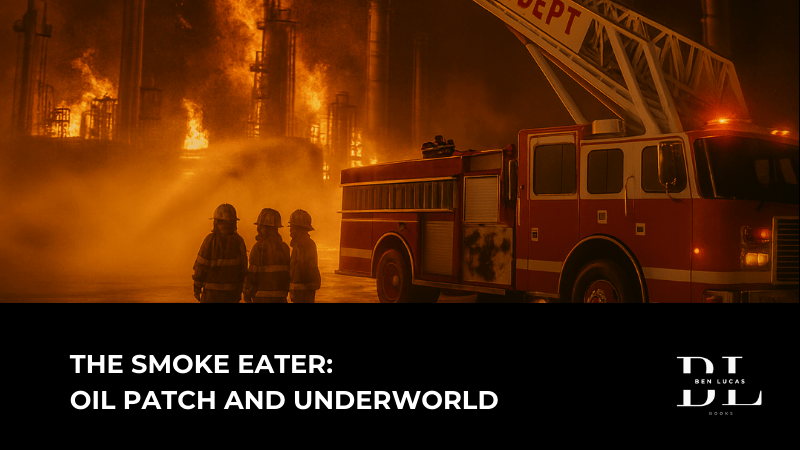
When you hit “publish” on a book, it’s not just a button click—it’s the exhale of years of imagining, drafting, tearing pages apart, and piecing them back together again. My new novel, The Smoke Eater, has finally stepped out into the world, and honestly? It feels like sending a kid to their first day of school. You’re proud, nervous, and more than a little curious to see how it survives outside your hands.
But here’s the thing—I didn’t write this story in a vacuum. The world of The Smoke Eater is stitched together from shadows I knew firsthand. I worked in the oil and gas patch, and that experience—those transient workforces, those booming paycheques, those makeshift man camps—gave me a front-row seat to the ways crime sneaks in when the lights are bright and the money flows. What better soil to grow a crime novel in?
This blog is my attempt to peel back the creative layers. Let’s talk about how the gritty realities of the oil patch became a stage for crime in The Smoke Eater—and how I blended fact, memory, and imagination into fiction that feels uncomfortably close to reality.
The Oil Patch as a Thriller Backdrop
One of the first creative decisions I made was to treat the oil patch itself like an major thriller component in the book. Anyone who has worked in the industry knows the atmosphere is thick—it hums with diesel, groans under machinery, and rattles with the push-pull of supply and demand. Towns swell overnight when a project is announced, then hollow out just as quickly when it finishes. That transience isn’t just physical—it’s psychological. People arrive, do their shift, and vanish.
Danger is everywhere!
For storytelling, that kind of instability is gold. You’ve got a town that doesn’t know its own identity anymore, where locals eye newcomers with suspicion, and workers know they won’t be around long enough to build roots. It’s a perfect environment for organized crime to slip in unnoticed.
Why Transience Breeds Trouble
When thousands of workers pour into a region with fat cheques and not much to spend them on, the vacuum fills fast. Bars overflow. Drug dealers follow the money. Small-town law enforcement, used to handling a couple of DUIs a month, suddenly has a meth ring or fentanyl pipeline setting up shop in its backyard.
Research backs this up. Studies have shown that oil and gas “man camps” often coincide with spikes in violence, substance abuse, and even human trafficking (https://lawblogs.uc.edu/ihrlr/2021/05/28/pipeline-of-violence-the-oil-industry-and-missing-and-murdered-indigenous-women). These camps aren’t designed for community—they’re designed for efficiency. And where there’s no community, there’s no accountability.
That’s the knife-edge I tried to capture in The Smoke Eater. My fictional town is a mirror of so many real ones, where the oil boom brought prosperity, but also a shadow economy that thrived right under the noses of folks too busy to notice—or too scared to speak.
The Lure of Quick Cash
Another root I tapped into: money. Oil work pays well. In some cases, absurdly well for the hours. For young men fresh out of high school, it can feel like winning the lottery—until they realize the costs. Easy money is a magnet for the drug trade. Dealers know these workers will pay top dollar to take the edge off the twelve-hour shifts.
But organized crime doesn’t stop at selling weed to rig hands. In Mexico, cartels have turned fuel theft into an empire. By 2018, authorities were finding over 15,000 illegal pipeline taps a year, compared to a couple hundred a decade earlier (https://www.asisonline.org/security-management-magazine/articles/2023/06/fuel-theft-and-cartels/seeking-revenue-cartel-fuel-thefts). In Ecuador, pipeline theft and extortion have cost the state-run oil company over $215 million in just two years (https://www.reuters.com/markets/commodities/fuel-theft-violence-siphoning-215-million-ecuador-oil-industry-2024-12-12).
That real-world backdrop shaped my fictional villains. In The Smoke Eater, they aren’t cartoon criminals—they’re entrepreneurs of the underworld, seizing opportunity where oversight is weakest.
The Human Cost: Workers in the Middle
Something I wanted to explore was how workers themselves become pawns. These guys aren’t hardened criminals. Most are just chasing a paycheque. But exhaustion, loneliness, and distance from home chip away at judgment. Drugs and alcohol become coping mechanisms. Some fall into debt. Some get recruited to “look the other way” on a job site. Before long, you’ve got good people tangled in bad webs.
And that’s where crime fiction gets interesting—when the line between villain and victim blurs. I wanted readers of The Smoke Eater to feel that tension. To ask: is this guy bad, or is he just broken?
Writing the Patch into Fiction
From a craft perspective, I had to balance authenticity with accessibility. Too much jargon and you lose readers. Too little, and the setting feels fake. So I used what I call the salt method: sprinkle real terms—“hot shot crew,” “flare stack,” “safety stand-down”—without overexplaining. If you’ve been there, it resonates. If you haven’t, it still feels textured and real.
I also leaned on rhythm. Crime fiction thrives on pace, but oil patch life is a strange blend of frantic and boring. Twelve hours of monotony punctuated by moments of sheer panic. I wrote in that rhythm. Long, dragging scenes that suddenly snap into chaos. It keeps readers off balance in the same way workers often are.
Organized Crime: Fiction Meets Reality
One of my favorite things about crime fiction is how it echoes headlines. When I read about cartel fuel theft in Mexico or gang pipeline taps in Ecuador, I didn’t just see news stories—I saw plot devices. Crime fiction thrives on plausibility. Readers should finish a chapter and wonder, Could this really happen here?
And the answer, in the oil patch, is yes. It already does.
Crime, Culture, and Community
But it’s not just about drugs and stolen fuel. It’s about culture. Boomtowns change the DNA of small towns. Rents skyrocket. Schools get overcrowded. Policing shifts from community relations to triage. And locals feel pushed out of their own homes. That resentment creates fertile ground for distrust, which organized crime can exploit.
This is something I dug into in The Smoke Eater. Crime isn’t an outsider problem—it’s a community one. And sometimes, the people you thought were protecting you are the very ones greasing the wheels for the underworld.
Creativity and Real-World Roots
The real creative challenge? Not letting the real-world grit overwhelm the story. The Smoke Eater is crime fiction, not a policy paper. But grounding it in truths makes the fiction sting harder.
Think of it like blending oil and water—on their own, they separate. But shake them hard enough, they mix into something new. That’s what writing this book felt like: shaking together lived experience, hard headlines, and fictional suspense until it turned into a story.
Wrapping It Up: The Roots and the Story
So where does that leave us? With a crime novel that owes as much to oil rigs and man camps as it does to classic noir tropes. With characters who bleed reality even as they walk through fictional streets. With a story that whispers, this could happen in your town too.
Let me put it plainly instead of that confusing “TL;DR” shortcut:
Key takeaways from both the oil patch and The Smoke Eater:
- The oil industry’s transient workforce and oversized paycheques create cracks that crime seeps into.
- Organized crime follows opportunity—whether it’s dealing drugs in man camps or tapping pipelines in Mexico and Ecuador.
- Fiction gets sharper when it’s sharpened on reality. Readers feel the truth even when it’s dressed up as story.
- Writing from lived experience isn’t just cathartic—it’s transformative. It turns rough memory into crafted narrative.
And most importantly? The Smoke Eater is out in the world. A novel born from oil patch dust and underworld shadows, finally ready to breathe in readers’ hands.
Available September 25, 2025, from Amazon:
To order your copy now, click your home country!
USA – https://www.amazon.com/dp/B0FNQ5Y8BB
Canada – https://www.amazon.ca/dp/B0FNQ5Y8BB
UK – https://www.amazon.co.uk/dp/B0FNQ5Y8BB
Australia – https://www.amazon.com.au/dp/B0FNQ5Y8BB
Germany – https://www.amazon.de/dp/B0FNQ5Y8BB
France – https://www.amazon.fr/dp/B0FNQ5Y8BB
Spain – https://www.amazon.es/dp/B0FNQ5Y8BB
Italy – https://www.amazon.it/dp/B0FNQ5Y8BB
Netherlands – https://www.amazon.nl/dp/B0FNQ5Y8BB
Japan – https://www.amazon.co.jp/dp/B0FNQ5Y8BB
Brazil – https://www.amazon.com.br/dp/B0FNQ5Y8BB
 Ben Lucas