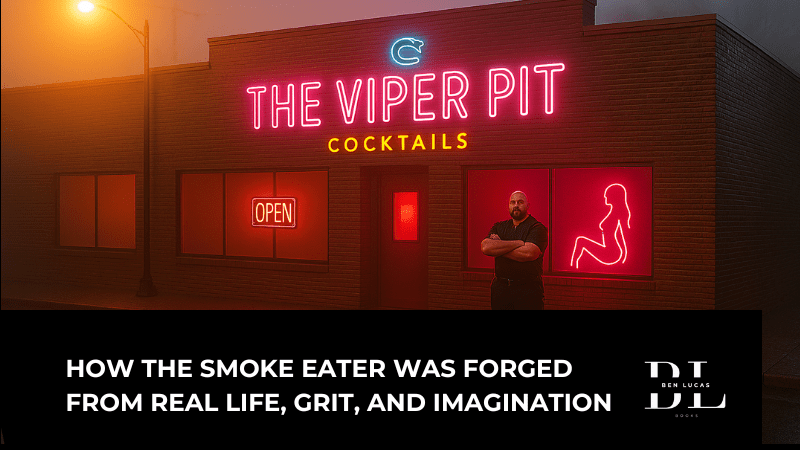
You could say The Smoke Eater was thirty years in the making. But that’s only part of the story. (Oh, the book is coming out on Amazon at the end of September, 2025).
I’ve spent the better part of my life working in oil and gas—wander the grounds across Canada and the U.S., and even into the Middle East. I’ve seen small towns explode with promise and buckle under pressure. I’ve seen good people do bad things when money and power hit the fan and spray everyone with shit. And I’ve seen what happens when systems—that include morals, politics, or industrial economics—start to crack.
In my life, I’ve seen people chase profit under the table, cut corners at others’ expense, and exploit the vulnerable just to get a step ahead.
That’s where this story comes from.
The Smoke Eater isn’t just a crime novel or a small-town drama. It’s the first book in what I hope will be a long series (that will also take place across the world), but interestingly, it’s also a prequel to two books I’d already written. I circled back, wanting to understand how the world I have built—one full of fractured loyalties and buried secrets—actually began. So I needed to go back to the source. Back to when the first cracks appeared. Before the town was fully lost.
When going back, (creating this book) there’s the what if—the question that drives any good story. My what if came straight from experience. What if someone—or even a group—living in a struggling town decided to partner with the organized crime already embedded in their region, believing it was the only way to save their home? What if their intentions were good at first, but the price was their soul? And what if, to survive, they had to betray each other?
It’s fiction. But I didn’t expect so much of my own life to bleed onto the page.
The Towns That Couldn’t Keep Up
Hillfort, the fictional setting of The Smoke Eater, could be anywhere—Alberta, Wyoming, Texas, North Dakota. I’ve spent time in a lot of them. Real towns. Real places that were promised prosperity and ended up overwhelmed. Places where oil or gas discoveries brought in thousands of transient workers, overburdened roads, crashed housing markets, and stressed every ounce of the local infrastructure—they three years later the local were scambling to pick up the slack because the industry pulled out and left them to rot.
I’ve seen towns double in size overnight. Truck traffic twenty-four hours a day. Gas stations with lineups six deep at 3 a.m. Hospitals with wait times that tripled. Police departments stretched thin. Fire crews working with barely functioning gear. And while the money poured in, the taxes that were collected didn’t cover the burden of success.
It was the same sort of story, where municipal budgets couldn’t keep up. Small-town leadership wasn’t ready. And the cracks widened fast. If you’re not prepared for it, the problems can become a national outcry for help.
That tension—promise versus collapse—is everywhere in this book.
Watching Morality Slip
One of the hardest lessons I learned in oil and gas is that a mission statement only matters until something more profitable gets in the way.
I’ve known people who stood firm on their values—talking safety and ethics in boardrooms and lunchrooms—until those values came with a price. When the pressure kicked in, the rules were bent. When the clock ran out, shortcuts surfaced. And once the regulators cleared out, yesterday’s sins sometimes quietly disappeared.
That’s where my characters come from. Not one person, but many. People who meant well, who started with integrity, but were slowly worn down—by ambition, exhaustion, fear, or the simple instinct to stay ahead of the game.
Fire Chief Dave Fulton, one of the central figures in The Smoke Eater, begins with a clear sense of duty. He wants to do the right thing. But the ground keeps shifting beneath him. His department is underfunded, his crew is splintering, and his personal life is cracking at the seams. Like so many I’ve seen in real life, Dave doesn’t collapse all at once—he erodes.
Then there’s Police Chief Jim Harris. He’s built a system of quiet compromises. He keeps things running through control, not chaos. He’s not the villain—he’s just figured out how to survive.
And Elijah—Elijah is something else entirely. He’s not the cause of the corruption. He’s the outsider who sees the cracks and knows exactly how to pry them open.
Drawing Inspiration: The Shield and Fargo
I’ve always believed the best stories come from characters pushed to the edge. That’s why The Shield stuck with me. It was gritty, tense, and morally murky. Watching cops bend the rules for what they believed was the greater good—and then watching the cost of those choices catch up with them—was fascinating. That dynamic of control, loyalty, and internal decay shaped a lot of how I approached this story.
Then there’s Fargo, especially Season 2. It showed how organized crime can exist in the background, moving like a shadow across the land. The tone was exactly what I wanted: quiet dread, explosive consequences. It’s not jump-scare horror—it’s dread rooted in reality. It’s knowing something awful is coming, but not knowing from where. Those small Mid-West town reminded of the various places that I had spent so much time, and that they are shaped by their own boom and busts.
I wanted The Smoke Eater to live in that space. A place where corruption isn’t flashy but it’s more systematic. I wanted danger not to be just one bad guy—but to be something that sucking the essence out the town and everyone in it.
What’s Real and What’s Invented
Hillfort is fictional, but its bones come from dozens of real places. The drug trade among oilfield workers? That’s real. The criminal networks hovering just outside of industrial camps? Also real. I’ve seen it. Quiet, constant, and always one step ahead of the people trying to stop it.
Of course, I’ve taken liberties. I’ve built scenes and story arcs from scratch. I’ve dramatized. But every lie the characters tell, every deal made in the shadows, every ethical line crossed—that comes from something I’ve either lived, witnessed, or heard whispered in a office trailer out in the patch.
Why a Prequel First?
It’s kind of backwards, I know. I’d already written two books set in this world before The Smoke Eater. But something about it kept pulling at me. I wanted to understand how the fractures started. How a town that once stood for something lost its way. I wanted to know what happened before the real damage was done.
So I wrote the beginning afterwards.
And now, it sets the stage for everything to come.
Three Decades in the Making
I’ve been working on fiction for almost twenty years—quietly, in between jobs, in field trailers, on hotel beds, during long nights when the world wouldn’t stop turning. All that is based on my thirty-year career. This book is the product of that persistence. Of shaping moments, scenes, and voices from all those years into something sharp and true.
The Smoke Eater is the start of something bigger—a long series, I hope. But more than that, it’s a story I needed to tell. A way of processing the things I’ve seen and asking questions that never really go away.
Questions like:
What’s the cost of survival?
Where’s the line between justice and revenge?
And when push comes to shove, do we really live by the values we claim to believe in?
Stay gritty,
Ben Lucas
 Ben Lucas